
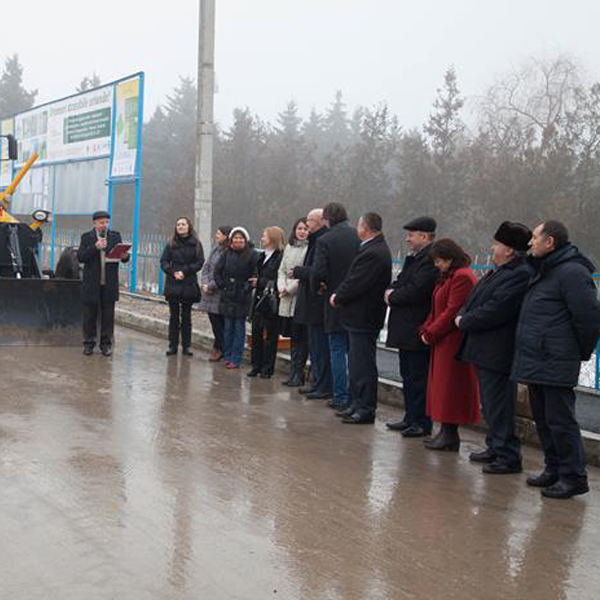
The town halls of Ciuciuleni, Drăgușenii Noi, Pașcani and Secăreni (Hîncești district) have joined forces and can now jointly handle road maintenance and snow clearing at local level. Yesterday, 22 January, the Ciuciuleni Inter-Community Enterprise (ICE) for municipal services was launched – a first of its kind.
“Thanks to the new inter-community service, we have been able to clear twice the area of snow with our own resources, at half the cost. The substantial savings in local budgets help us redirect money to other community priorities,” said Grigore Grigoraș, mayor of Ciuciuleni, at the launch of the new enterprise.
The event, held in Ciuciuleni, presented the mandate of the inter-community enterprise and tested the multifunctional equipment serving these localities. As a result, the four town halls and more than 13,000 residents will no longer have to wait two or three days for the tractor from Hîncești to come and clear the snow.
Jesper Toftlund, representative of the Government of Denmark, said it was an honour to see that the contribution of the Danish people is so useful in improving living conditions in the Republic of Moldova: “It is a particular pleasure to see that children can get to school without difficulty in winter, the elderly can fetch drinking water, and people have access to national roads.”
Victoria Cujbă, Head of the Decentralisation Policy Directorate of the State Chancellery, said that the decentralisation reform will make town halls stronger and more autonomous. “Inter-community cooperation is an innovative method for Moldovan town halls that cannot provide essential services to citizens on their own. The Government of Moldova encourages other town halls across the country to adopt this model. We are confident that only through joint efforts will we have a cleaner, brighter Moldova with accessible roads for our citizens,” she said.
The Ciuciuleni ICE is one of 10 inter-community cooperation projects implemented in several districts of Moldova, putting into practice the National Decentralisation Strategy approved by Parliament in April 2012. Inter-community enterprises are a viable alternative, especially for small town halls with fewer than 5,000 inhabitants that lack the resources to provide public services on their own. In Moldova, 86% of localities have fewer than 5,000 inhabitants.
The grant for this project is USD 100,000. The project is implemented by the Institute for Urban Development with the support of the Joint Integrated Local Development Programme (UNDP Moldova and UN Women), funded by the Government of Denmark.
For further information: Cristina Moisei-Rabei, IDU project development consultant, tel. 022 21 14 67. More about the project: trm.md (in Romanian).